

| Treatment | Vasectomy Reversal Microsurgery |
|---|---|
| Also known as | Vasectomy reversal, vasovasostomy, vasoepididymostomy |
| Used for | Restoring the passage of sperm after a previous vasectomy |
| How it works | Microsurgery reconnects the vas deferens or, when necessary, connects the vas deferens directly to the epididymis to allow sperm to enter the semen again. |
| Anaesthesia | Usually general anaesthesia |
| Treatment setting | Day surgery or short hospital stay |
| Recovery | Most men resume light activities within several days, with gradual return to normal activities as advised by the surgeon |
| Suitable for | Selected men wishing to restore fertility after vasectomy |
What is Vasectomy Reversal Microsurgery?
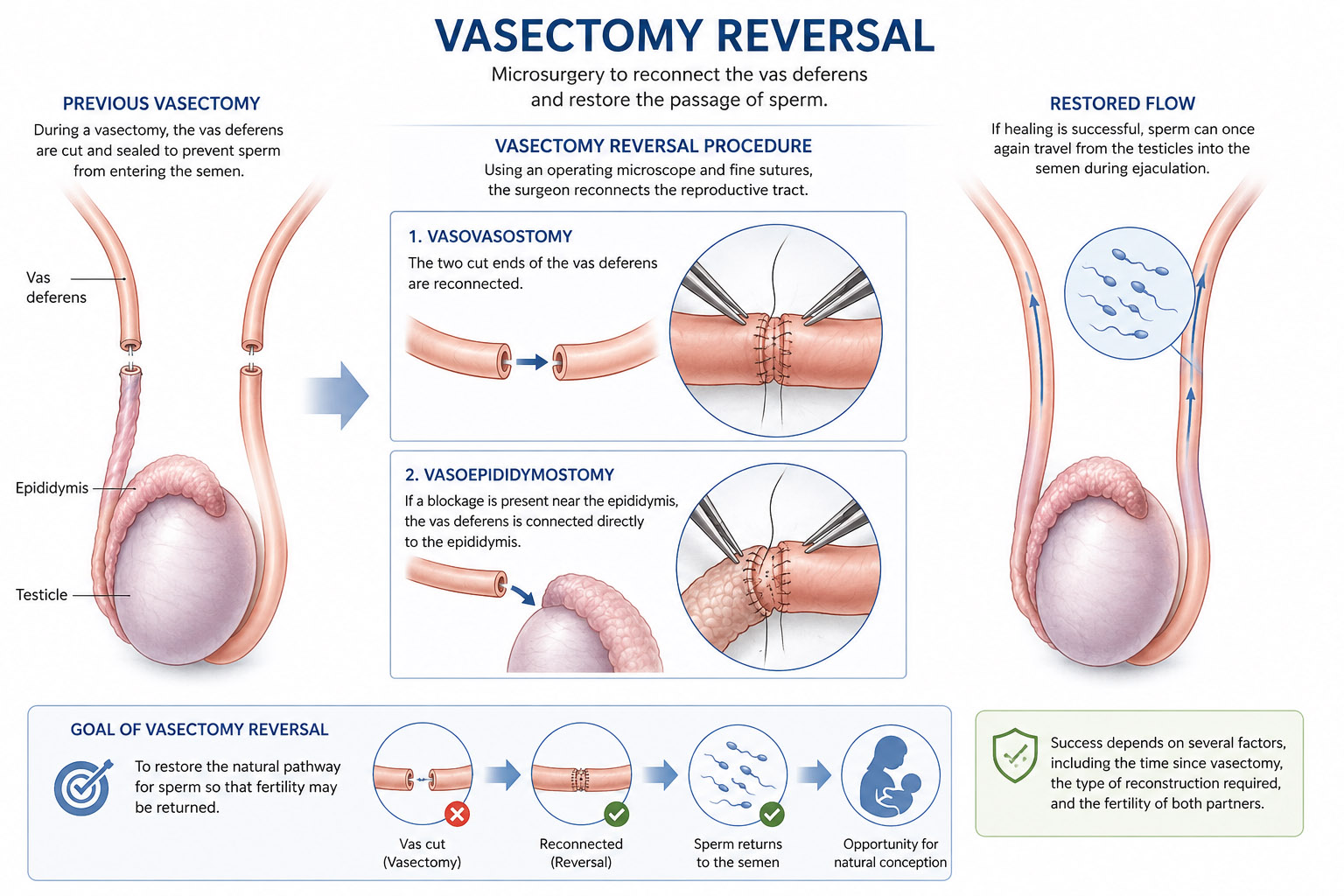
Vasectomy reversal microsurgery is a specialised surgical procedure that aims to restore fertility after a previous vasectomy. The procedure reconnects the reproductive tract so that sperm can once again travel from the testicles into the semen during ejaculation (link to service page).
Using an operating microscope and specialised microsurgical instruments, the surgeon performs one of two reconstructive procedures depending on the findings at the time of surgery. Vasovasostomy reconnects the two divided ends of the vas deferens, while vasoepididymostomy connects the vas deferens directly to the epididymis when a blockage closer to the testicle prevents normal sperm passage. The most appropriate technique is determined during the operation based on the condition of the reproductive tract.
Watch Dr Joe Lee explain how a vasectomy works and what changes occur to the vas deferens, providing helpful background before understanding how vasectomy reversal microsurgery is performed.
@drjollyurology What’s a vasectomy, really? ✂️ A quick procedure that stops sperm, not your manhood. urology menshealth vasectomy doctorsoftiktok fyp
♬ original sound - Dr Joe Lee | Urology - Dr Joe Lee | Urology
How Does Vasectomy Reversal Microsurgery Work?
A vasectomy reversal aims to restore the pathway that allows sperm to travel from the testicles into the semen. During surgery, the surgeon carefully examines the reproductive tract and selects the most appropriate microsurgical reconstruction based on the findings.
Because the procedure is performed using an operating microscope and extremely fine sutures, it requires a high level of microsurgical precision. The exact technique used depends on whether sperm can still pass through the vas deferens or whether a blockage has developed closer to the epididymis.
- Previous vasectomy — During a vasectomy, the vas deferens are divided and sealed to prevent sperm from entering the semen.
- Assessment during surgery — The surgeon examines the fluid within the vas deferens to determine the most appropriate method of reconstruction.
- Vasovasostomy — If conditions are favourable, the two divided ends of the vas deferens are precisely reconnected using microsurgical techniques.
- Vasoepididymostomy — If a blockage has developed closer to the epididymis, the vas deferens is connected directly to the epididymis to bypass the obstruction.
- Restoration of sperm transport — If healing is successful, sperm may once again travel through the reproductive tract and become present in the semen.
Who May Benefit from Vasectomy Reversal Microsurgery?
Vasectomy reversal microsurgery may be considered by men who wish to restore their fertility after a previous vasectomy. Whether the procedure is suitable depends on several factors, including the time since the vasectomy, the condition of the reproductive tract and the fertility of both partners.
You may benefit from vasectomy reversal microsurgery if you:
- Have had a previous vasectomy — You previously chose permanent contraception but now wish to restore the passage of sperm into the semen.
- Wish to have biological children in the future — You would like the opportunity to conceive naturally after a previous vasectomy.
- Have experienced a change in family circumstances — Reasons may include a new relationship, remarriage, changes in family planning goals (link to service page) or other personal circumstances.
- Have a healthy reproductive partner — The fertility of both partners is an important consideration when planning treatment and estimating the likelihood of pregnancy.
- Prefer natural conception — You would like to pursue pregnancy through natural conception instead of assisted reproductive techniques, where appropriate.
The suitability of vasectomy reversal microsurgery is determined after a comprehensive assessment of your medical history, previous vasectomy, fertility goals and the reproductive health of both partners.
What to Expect During Vasectomy Reversal Microsurgery?
Types of Varicocele Surgery
Several surgical techniques can be used to repair a varicocele. The most appropriate approach depends on the patient’s condition, the surgeon’s assessment and individual treatment goals.
- Microsurgical Varicocelectomy — This is the most commonly performed and preferred technique. A small incision is made in the groin, and a surgical microscope is used to identify and seal the enlarged veins while preserving the arteries, lymphatic vessels, and vas deferens.
- Laparoscopic Varicocelectomy — This minimally invasive technique uses small abdominal incisions and a camera to access and treat the affected veins. Although effective, it is generally performed less frequently than the microsurgical approach.
- Open Varicocelectomy — Traditional open surgery may also be performed in selected situations. However, it has largely been replaced by microsurgical techniques because they offer improved visualisation and may reduce the risk of complications and recurrence.
Microsurgical varicocelectomy is widely regarded as the preferred technique because it provides excellent visualisation of the blood vessels while helping preserve important surrounding structures, which may reduce complications and lower the likelihood of recurrence.
What to Expect During Varicocele Surgery
Before Surgery
Before surgery, your urologist will perform a detailed assessment to determine whether vasectomy reversal is appropriate and discuss the factors that may influence the likelihood of success. This typically includes:
- Consultation — Discussion of your medical history, fertility goals and reasons for seeking vasectomy reversal.
- Medical and fertility history — Review of previous surgeries, medical conditions, medications and reproductive history.
- Previous vasectomy history — Assessment of when the vasectomy was performed and whether any previous reversal attempts have been made.
- Physical examination — Examination of the scrotum and reproductive structures to assess suitability for surgery.
- Partner fertility discussion — Consideration of the reproductive health of both partners, as pregnancy depends on male and female fertility factors.
- Pre-operative instructions — Guidance regarding fasting, medications and preparation for surgery.
During Surgery
Vasectomy reversal is performed under general anaesthesia using specialised microsurgical techniques. During the procedure, your surgeon will:
- Administer general anaesthesia — The procedure is performed while you are asleep and comfortable.
- Perform microsurgical assessment — The vas deferens and surrounding structures are examined using an operating microscope.
- Perform vasovasostomy or vasoepididymostomy — The most appropriate reconstructive procedure is selected based on the findings during surgery.
- Reconnect the reproductive tract — Extremely fine microsurgical sutures are used to precisely reconstruct the sperm pathway.
- Close the surgical incision — The incision is carefully closed once the reconstruction has been completed.
After Surgery
Most patients return home on the same day or after a short hospital stay, depending on the individual surgical plan. Following surgery, you can generally expect:
- Recovery and monitoring — You will be observed while recovering from anaesthesia before discharge.
- Pain management — Mild discomfort, swelling or bruising is expected initially and can usually be managed with medication.
- Scrotal support — Wearing supportive underwear or a scrotal support may improve comfort during the early recovery period.
- Activity restrictions — Heavy lifting, strenuous exercise and sexual activity should be avoided until advised by your surgeon.
- Follow-up appointments — Your recovery and wound healing will be monitored during scheduled reviews.
- Semen analysis — Semen samples are assessed during follow-up to determine whether sperm have returned to the semen after surgery.
Benefits of Vasectomy Reversal Microsurgery
For appropriately selected patients, vasectomy reversal microsurgery may restore fertility while allowing the possibility of natural conception. Potential benefits include:
- May restore sperm to the semen — Successful microsurgical reconstruction can re-establish the passage of sperm into the semen.
- Opportunity for natural conception — Restoring sperm transport may allow couples to conceive naturally without assisted reproduction.
- Microsurgical precision — The procedure is performed using an operating microscope and specialised microsurgical instruments to maximise precision during reconstruction.
- May avoid sperm retrieval and IVF in suitable couples — When the reversal is successful, some couples may be able to pursue natural conception without requiring surgical sperm retrieval or assisted reproductive techniques.
- Long-term fertility potential — If sperm transport is successfully restored, fertility may be maintained over the long term without repeated treatment.
- Individualised surgical approach — The choice between vasovasostomy and vasoepididymostomy is made during surgery based on the condition of the reproductive tract, which allows the treatment to be tailored to each patient.
Risks and Limitations of Vasectomy Reversal Microsurgery
Vasectomy reversal microsurgery is a safe and well-established procedure when performed by an experienced microsurgeon. However, as with any operation, it carries potential risks and successful restoration of fertility cannot be guaranteed.
Potential risks and limitations include:
- Bleeding or bruising — Mild bleeding, bruising or swelling around the surgical site may occur during the early recovery period.
- Infection — Although uncommon, infection can develop at the incision site and may require treatment with antibiotics.
- Pain or discomfort — Mild postoperative discomfort is expected initially and generally improves as healing progresses.
- Scar tissue formation — Scar tissue may develop during healing and, in some cases, affect the passage of sperm through the reconstructed reproductive tract.
- Failure to restore sperm to the semen — Despite successful surgery, sperm may not return to the semen if reconstruction is unsuccessful or sperm production has been affected.
- Pregnancy cannot be guaranteed — Even when sperm return to the semen, successful pregnancy depends on multiple male and female fertility factors.
- A more complex reconstruction may be required — If a blockage is identified near the epididymis, a vasoepididymostomy may be necessary instead of a vasovasostomy.
- Success decreases over time — The likelihood of restoring sperm to the semen generally decreases as the interval between the original vasectomy and reversal becomes longer.
- Additional fertility treatment may still be required — Some couples may still require assisted reproductive treatments, such as sperm retrieval (link to service page) with IVF or ICSI, depending on the outcome of surgery and other fertility factors.
Your urologist will discuss the expected benefits, potential risks and the factors that may influence your individual outcome before recommending surgery.
What Results Can Patients Expect from Vasectomy Reversal Microsurgery?
The goal of vasectomy reversal microsurgery is to restore the passage of sperm into the semen and provide the opportunity for future biological children. However, the success of the procedure varies between individuals and depends on several surgical and fertility-related factors.
Following vasectomy reversal microsurgery, patients may experience:
- Return of sperm to the semen — If the reconstruction heals successfully, sperm may once again be present in the ejaculate.
- Gradual return of fertility — The time required for sperm to reappear in the semen varies between patients and depends on the type of reconstruction performed.
- Pregnancy depends on both partners — Although restoring sperm to the semen is an important step, successful pregnancy also depends on the fertility of the female partner and other reproductive factors.
- Success influenced by the time since vasectomy — Men who undergo reversal sooner after their vasectomy generally have higher success rates than those with a longer interval between procedures.
- Follow-up semen analysis — Regular semen analyses are performed after surgery to monitor the return of sperm and assess the success of the reconstruction.
- Long-term follow-up — Ongoing review allows your urologist to monitor recovery, semen quality and discuss further fertility options if required.
While vasectomy reversal microsurgery can successfully restore fertility in many suitable patients, your urologist will discuss realistic expectations based on your individual circumstances.
Summary
Vasectomy reversal microsurgery is a specialised procedure that reconnects the reproductive tract after a previous vasectomy, which allows sperm to return to the semen in suitable patients. Using advanced microsurgical techniques, the procedure aims to restore fertility while preserving the opportunity for natural conception whenever possible.
The success of vasectomy reversal depends on several factors, including the time since the original vasectomy, the condition of the reproductive tract and the fertility of both partners. An individualised assessment is essential to determine the most appropriate treatment approach and expected outcomes.
If you are considering restoring your fertility after a previous vasectomy, schedule a consultation with Dr Joe Lee to discuss whether vasectomy reversal microsurgery may be an appropriate option for you.