


| Definition | Peyronie’s disease is a condition in which scar tissue, or fibrous plaque, forms within the penis and causes abnormal curvature or other changes in its shape. |
|---|---|
| Stages | The condition generally progresses through an active phase, when pain and curvature may change, followed by a more stable phase in which the deformity has largely settled. |
| Causes | The exact cause is not always clear, but repeated or significant penile injury, genetic susceptibility and certain medical conditions may contribute. |
| Symptoms | Penile curvature, a hard plaque or lump, painful erections, shortening or narrowing of the penis and difficulty with sexual intercourse. |
| Diagnosis | Diagnosis is usually based on medical history and physical examination, with assessment of the curvature, plaque and erectile function; imaging may be used when appropriate. |
| Treatment | Management depends on the stage and severity and may include observation, medication for selected symptoms, traction or vacuum devices, injections, shockwave therapy and surgery for significant stable deformity. |
The condition may change during an active phase before becoming more stable. Treatment therefore depends on the stage of disease, type of deformity, erectile function and how much it affects sexual activity.
What Are the Stages of Peyronie’s Disease?
Peyronie’s disease does not necessarily remain the same from the time it first appears. Doctors often describe Peyronie’s disease as having an active phase and a stable phase, although the timing and progression can vary between men.
- Active or acute phase – during the active phase, the plaque and resulting deformity may still be changing. Pain during erections is more common, and the curvature may become more pronounced or change over time. Some men may also notice a developing plaque, indentation or shortening. Because the condition is still evolving, treatment decisions during this stage take into account the man's symptoms, the progression of the deformity and erectile function.
- Stable or chronic phase – the disease may eventually enter a stable phase, where the deformity is no longer changing substantially. Pain often becomes less prominent or disappears, while the curvature and other physical changes may remain. Once the deformity has stabilised, the main concern may be its effect on sexual function and whether correction is appropriate.
The transitions between phases is not determined by a single fixed timeframe. The clinical assessment is more important than simply how long the condition has been present.
Is a Curved Penis Always Peyronie’s Disease?
A naturally curved penis is not necessarily a sign of Peyronie’s disease.
Some men have a mild upward, downward or sideways curvature that has been present since they first developed erections. If the curve is stable, painless and does not interfere with sexual function, it may simply be part of their normal anatomy. Treatment is sometimes required when the congenitally curved penis makes intercourse painful or difficult.
Peyronie’s disease is more likely when there is a new or worsening curvature, particularly when it is accompanied by pain, a hard plaque, penile shortening, indentation or difficulty with erections or sexual intercourse.
The important distinction is therefore not whether the penis is perfectly straight, but whether there has been a significant change in its shape or whether the curvature is affecting function.
What Causes Peyronie’s Disease?
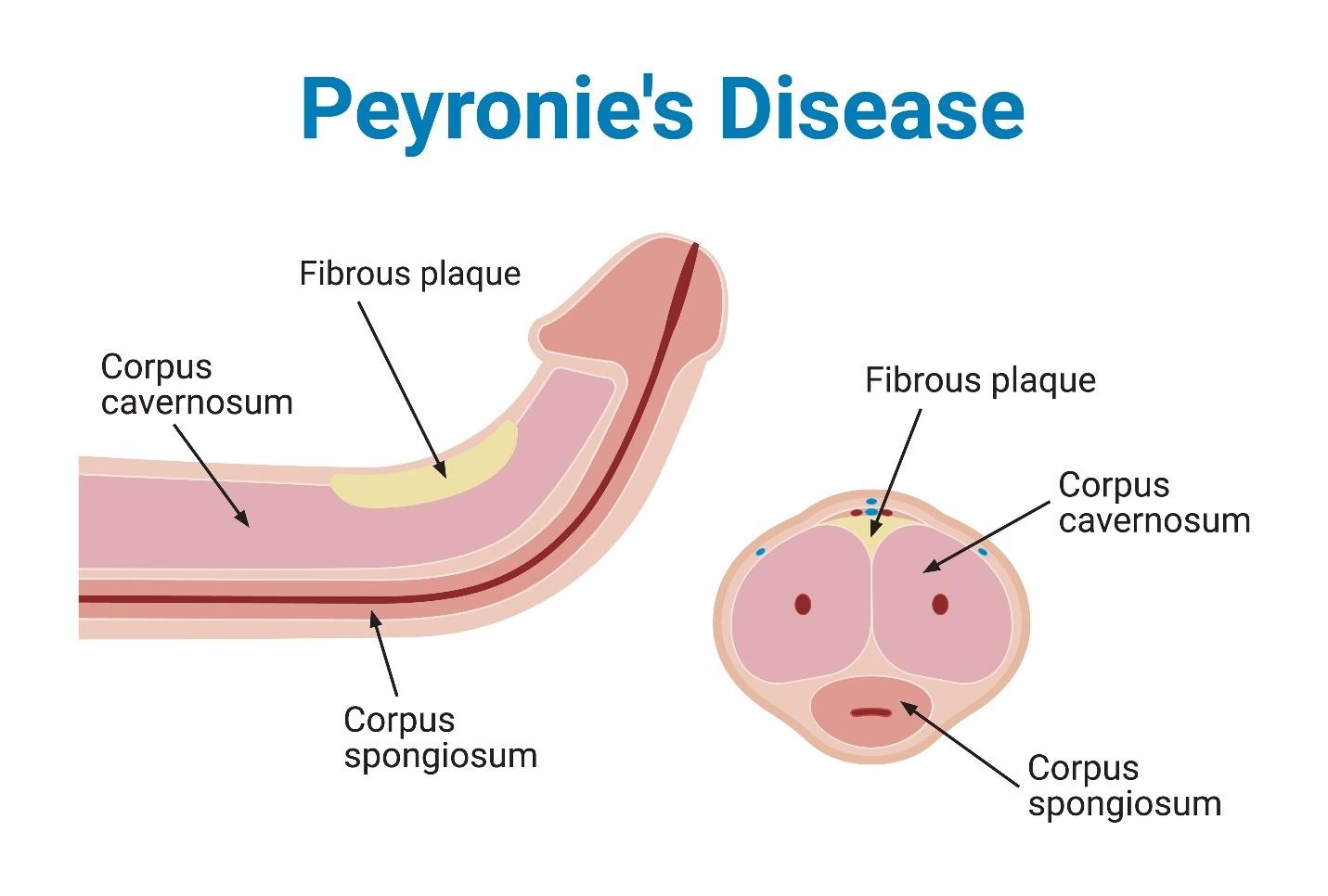
Peyronie’s disease is thought to develop when the tissue inside the penis undergoes injury followed by an abnormal healing response. The tissue injury may result from significant trauma or repeated minor mechanical stress causing numerous microtrauma, although many men do not recall any specific injury.
Normally, injured tissue repairs itself in a controlled way. In Peyronie’s disease, however, the healing process can result in excessive formation of fibrous scar tissue, known as a Peyronie’s plaque. This plaque is less flexible than the surrounding erectile tissue.
@drjollyurology Not all hardness is good. 🪨 Plaques from Peyronie’s disease can cause pain, curve, and softer erections. Here’s why you shouldn’t ignore it. #urology #doctor #menshealth #fyp #PeyroniesDisease #menshealthawareness #doctorsoftiktok
♬ original sound - Dr Joe Lee | Urology - Dr Joe Lee | Urology
When the penis becomes erect, healthy erectile tissue expands. A scarred area does not stretch to the same extent. This creates an imbalance in how different parts of the penis expand, causing the penis to bend towards the affected area. Depending on where the plaque forms, the resulting deformity may involve an upward, downward or sideways curve, as well as indentation or an hourglass appearance.
The exact reason why some men develop abnormal scarring while others recover normally is not fully understood.
What Are the Symptoms of Peyronie’s Disease?
@drjollyurology Curves aren’t always a problem…until they are. Pain, lumps, or worsening shape? See a doctor and get answers. 🩺 #urology #doctor #menshealth #fyp #PeyroniesDisease #menshealthawareness #doctorsoftiktok
♬ original sound - Dr Joe Lee | Urology - Dr Joe Lee | Urology
Not every man experiences all of these symptoms and the severity can vary considerably. The most noticeable change is often a change in the shape of the penis during erection, but Peyronie’s disease can affect men in several ways.
- Penile curvature – the penis may develop a new upward, downward or sideways curve. The degree of curvature can vary and may become more pronounced during the active phase
- A hard plaque or lump – a firm area may be felt beneath the skin of the penis. This is the fibrous plaque responsible for the abnormal stretching of the tissue
- Painful erections – pain is more commonly experienced during the active phase and may occur when the penis becomes erect
- Penile shortening – some men notice that their erect penis appears shorter than it was previously
- Indentation or hourglass deformity – scar tissue can cause one part of the penis to narrow or become indented during an erection, creating an hourglass appearance
- Erectile difficulties – changes in the structure of the penis, pain and the psychological impact of the condition can all contribute to difficulty achieving or maintaining an erection
Who Is More Likely to Develop Peyronie’s Disease?
Peyronie’s disease can occur at different ages, although it is more commonly diagnosed in middle-aged and older men.
Factors associated with a greater likelihood include:
- Increasing age – the tissues of the penis may become less elastic with age and may be more susceptible to injury and changes in the healing process. This may partly explain why Peyronie’s disease becomes more common as men get older.
- Connective tissue disorders – fibrotic conditions such as Dupuytren’s contracture are associated with Peyronie’s disease and may reflect a susceptibility to abnormal scar formation.
- Diabetes and metabolic disease – diabetes can affect blood vessels, tissue health and the body's normal healing response. These changes may make abnormal fibrosis more likely following tissue injury.
- Erectile dysfunction (ED) – men with erectile dysfunction may have a higher likelihood of developing Peyronie’s disease. The relationship is complex and may involve shared vascular and tissue changes, as well as greater mechanical stress when erections are less rigid.
- Previous penile trauma – significant injury can damage the tissues within the penis and trigger inflammation and repair. In susceptible men, this healing process may result in excessive fibrosis and plaque formation.
However, having one of these factors does not mean that a man will develop Peyronie’s disease and many men have no obvious risk factor at all.
What Complications Can Peyronie’s Disease Cause?

The disease does not affect every man in the same way. When the curvature or underlying tissue changes become significant, the condition can lead to complications that affect sexual function, penile shape and emotional wellbeing.
- Difficulty with sexual intercourse – significant curvature or narrowing can make penetration uncomfortable, difficult or, in more severe cases, impossible
- Erectile dysfunction – changes in the structure of the penis may interfere with erection quality. Pain and psychological distress can also contribute to difficulty achieving or maintaining an erection
- Loss of penile length – contraction of scarred tissue can reduce the apparent length of the erect penis
- Psychological distress – concerns about penile appearance, sexual performance or changes in intimacy can affect confidence, relationships and overall sexual wellbeing
Does Peyronie’s Disease Cause Erectile Dysfunction?
@drjollyurology Yes, Peyronie’s Disease can contribute to ED, but how? Find out more. #urology #doctor #menshealth #fyp #PeyroniesDisease #erectiledysfunctionisreal #menshealthawareness #doctorsoftiktok
♬ original sound - Dr Joe Lee | Urology - Dr Joe Lee | Urology
Peyronie’s disease can contribute to erectile dysfunction through several overlapping mechanisms.
The plaque can alter the normal structure and elasticity of the erectile tissue. In some men, this may interfere with the ability of the penis to expand and maintain sufficient rigidity during an erection. Significant curvature or narrowing may also make it mechanically difficult to maintain an erection suitable for sexual intercourse.
Pain during erections can further interfere with sexual activity. There may also be a psychological component, as concerns about penile appearance, sexual performance or the progression of the condition can contribute to anxiety and erectile difficulties.
This means that erectile dysfunction associated with Peyronie’s disease is not necessarily psychological. Structural, physical and psychological factors may all contribute, and treatment should address the factors affecting the individual man.
How Is Peyronie’s Disease Diagnosed in Singapore?

Diagnosis usually begins with a detailed discussion about when the curvature developed, whether it is changing and how it is affecting erections and sexual intercourse.
A physical examination allows our urologist to assess for plaques, areas of thickening and changes in the penile tissue.
Where appropriate, the assessment may include:
- Assessment of erectile function – our urologist may assess whether you can achieve and maintain an erection that is sufficiently firm for sexual activity. Understanding the degree of erectile dysfunction is important because it can influence the choice of treatment.
- Measurement of penile curvature – the degree of curvature may be measured during an erection using clinical assessment and, where appropriate, an angle-measuring device. The degree and direction of curvature can help determine the severity of the deformity and guide treatment planning.
- Induced erection assessment – in selected cases, medication may be used to produce an erection in the clinic so that curvature, indentation, instability and erectile rigidity can be assessed objectively, particularly before invasive treatment.
- Erect penile photographs – photographs taken from different angles may help document the direction and degree of curvature, particularly when the deformity is not obvious when the penis is flaccid.
- Penile ultrasound – ultrasound may be used when further assessment of the plaque, calcification or penile blood flow is required. It can provide additional information about the underlying penile tissue and erectile function.
A detailed assessment is particularly important before considering surgery because the type of deformity, erectile function and overall penile anatomy influence which procedure is most appropriate.
How Is Peyronie’s Disease Treated in Singapore?
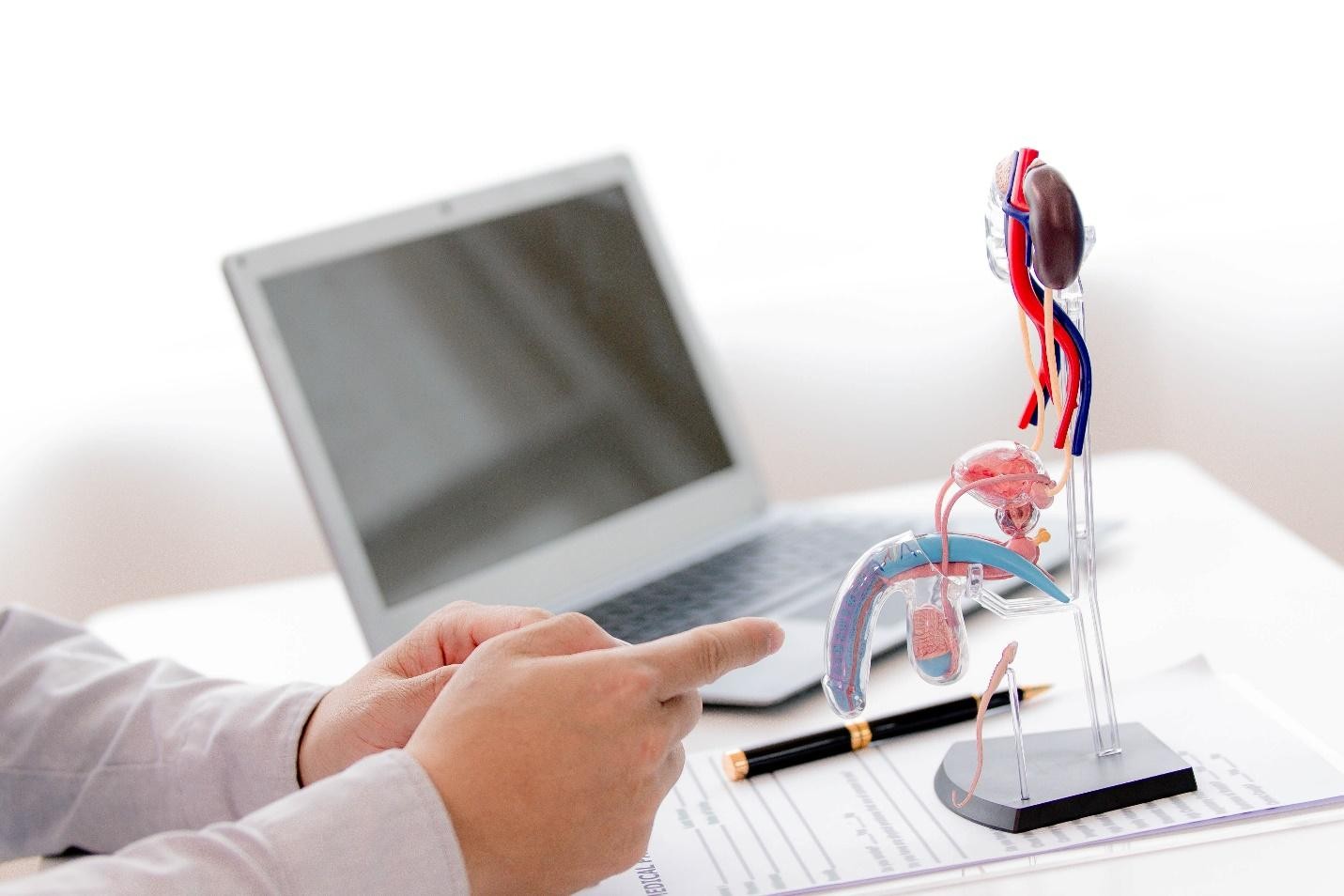
Treatment is highly individualised. The most appropriate approach depends on whether the condition is still changing, how severe the curvature is, whether there is pain and how significantly sexual function is affected.
The goals of treatment are generally to:
- Manage pain and symptoms
- Prevent or minimise further deterioration where possible
- Reduce significant curvature or deformity
- Improve or preserve sexual function
Non-surgical treatment and observation
Men with mild curvature, minimal symptoms and preserved sexual function may not need immediate intervention. During the active phase, management may focus on monitoring changes and controlling pain while the condition evolves.
Oral medication
@drjollyurology Real talk: Peyronie’s is structural. 💊 Meds can help in early stages, but advanced curves need more than pills. 🩺 #urology #doctor #menshealth #fyp #PeyroniesDisease #menshealthawareness #doctorsoftiktok
♬ original sound - Dr Joe Lee | Urology - Dr Joe Lee | Urology
Oral medication generally has a limited role in correcting established penile curvature. In selected men, medication may be used to manage symptoms such as pain during the active phase, but established plaque and structural deformity usually require a different treatment approach.
Pain-relieving medication may be used when pain is present, while other medicines may be prescribed when erectile dysfunction is also present. However, oral medication does not generally reverse established plaque-related curvature.
Shockwave therapy
Low intensity shockwave therapy (LiSWT) is applied over the area of the plaque to stimulate changes at the cellular level. This helps to reduce inflammation and pain in the active phase, allowing better recovery. The duration of this treatment is determined based on the response.
Penile traction therapy
Penile traction therapy applies controlled mechanical stretching and may help selected men reduce curvature and/or preserve or regain penile length. The amount of benefit varies and requires regular device use.
Vacuum devices
Vacuum erection devices may be used in selected men, particularly when erectile function is also affected. They may also form part of a broader conservative treatment strategy.
Injections into the plaque
Certain intralesional treatments may be injected directly into the plaque in selected patients to reduce curvature. Collagenase injections of the plaque can help to break down the excess collagen and scar tissue. The medication (known by the name Xiaflex) contains special enzymes that can help reduce the curvature by dissolving and softening the plaque.
Surgery
@drjollyurology When is surgery for Peyronie’s worth it? 📏 If the bend makes s*x painful or impossible, it may be time to straighten things out. 🩺 #urology #doctor #menshealth #fyp #PeyroniesDisease #menshealthawareness #doctorsoftiktok
♬ original sound - Dr Joe Lee | Urology - Dr Joe Lee | Urology
Surgery is generally considered when the deformity has become sufficiently stable and is significantly interfering with sexual intercourse or function. The choice of surgery depends largely on the severity and type of curvature, penile length, erectile function and the condition of the penile tissue.
The three main surgical approaches are:
- Plication – the penis is surgically straightened by placing sutures on the opposite side of the curvature. It can be effective for suitable men with adequate erectile function and penile length, although some degree of shortening may occur.
- Plaque incision and grafting – the scarred tunica is incised or released and reconstructed with graft material. This may be considered for selected men with more severe or complex deformities and adequate erectile function, particularly where shortening from plication would be undesirable.
- Penile implant – for men with Peyronie’s diseaseand significant erectile dysfunction that does not respond adequately to non-surgical ED treatment, a penile prosthesis may address both the erection problem and, where appropriate, the curvature.
No single treatment is best for every man. The choice depends on the degree and type of curvature, penile length, erectile function, plaque characteristics and treatment goals.
Why See an Andrology-Focused Urologist for Peyronie’s Disease?
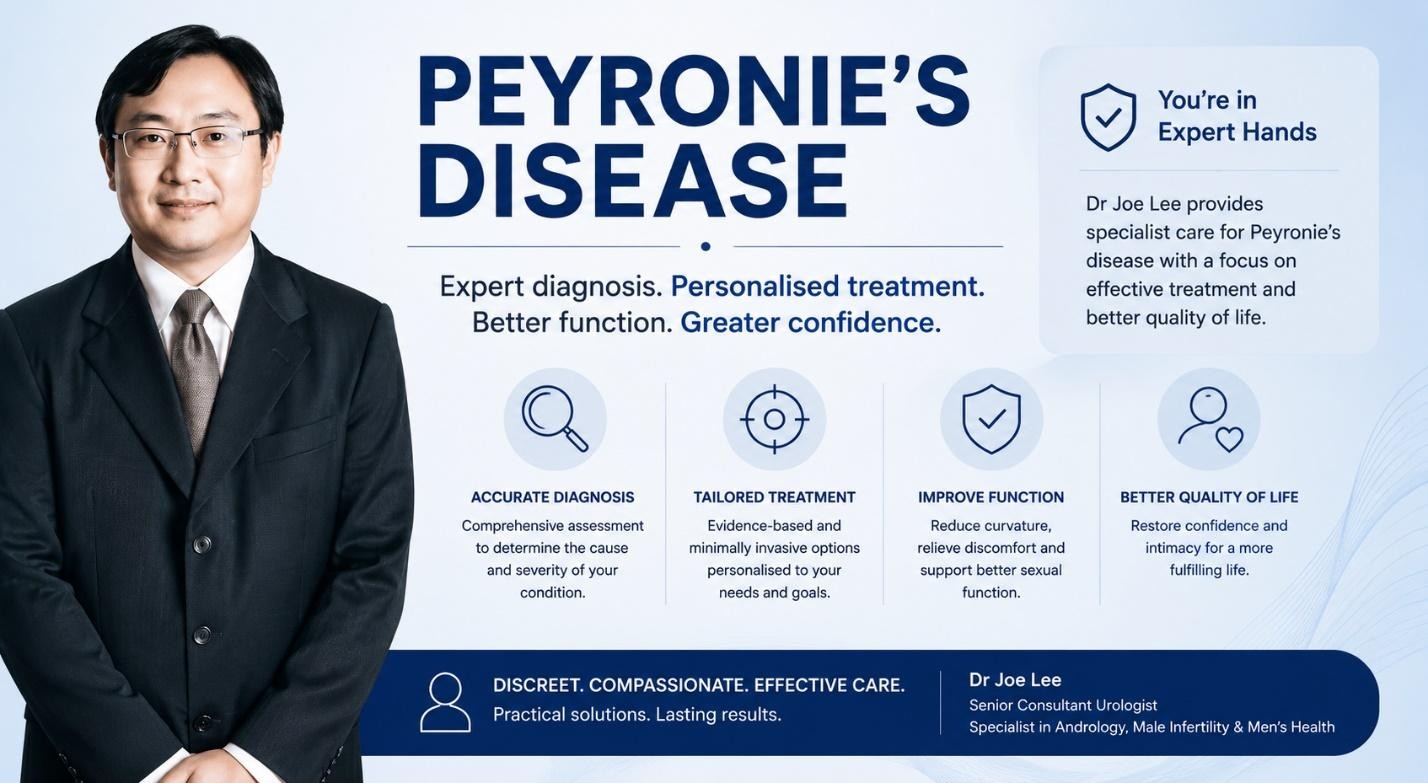
Peyronie’s disease can affect more than the shape of the penis, with curvature, plaque formation, pain and changes in erectile function potentially affecting sexual activity and overall wellbeing. An andrology-focused urologist can assess these aspects together rather than treating the curvature in isolation.
Dr Joe Lee is a Senior Consultant Urologist with a subspecialty focus in andrology and men’s health. His assessment considers the degree and direction of curvature, underlying plaque, pain, erectile function and how the condition is affecting sexual intercourse. Treatment can then be tailored to the individual, ranging from monitoring milder disease and non-surgical approaches to reconstructive surgery for more significant deformity.
A new change in penile shape, a hard plaque or lump, painful erections or difficulty with erections or sexual intercourse warrants assessment. Peyronie’s disease is a recognised medical condition that can affect sexual function and quality of life, and these concerns can be discussed confidentially during assessment.
Book an appointment with Dr Joe Lee for an individualised assessment of Peyronie’s disease and to discuss the most appropriate treatment options.
@drjollyurology Think Peyronie’s comes from too much solo time? 🚫 Myth. Here’s the truth behind the biggest PD misconceptions. 💡 #urology #doctor #menshealth #fyp #PeyroniesDisease #menshealthawareness #doctorsoftiktok
♬ original sound - Dr Joe Lee | Urology - Dr Joe Lee | Urology