


Treatment | Optical Urethrotomy |
Also known as | Direct Vision Internal Urethrotomy (DVIU), internal urethrotomy |
Used for | Selected short urethral strictures causing obstruction to urine flow |
How it works | A urethrotome is passed through the urethra and the stricture is incised under direct vision to widen the narrowed passage |
Procedure type | Minimally invasive endoscopic procedure |
Anaesthesia | May be performed under general, spinal or selected forms of local anaesthesia |
Incision | No external surgical incision |
Treatment setting | Hospital or surgical facility; often a short-stay procedure |
Catheter | A urinary catheter may be left temporarily after treatment |
Suitable for | Carefully selected patients, particularly those with a primary, single, short (<2 cm), non-obliterative bulbar urethral stricture |
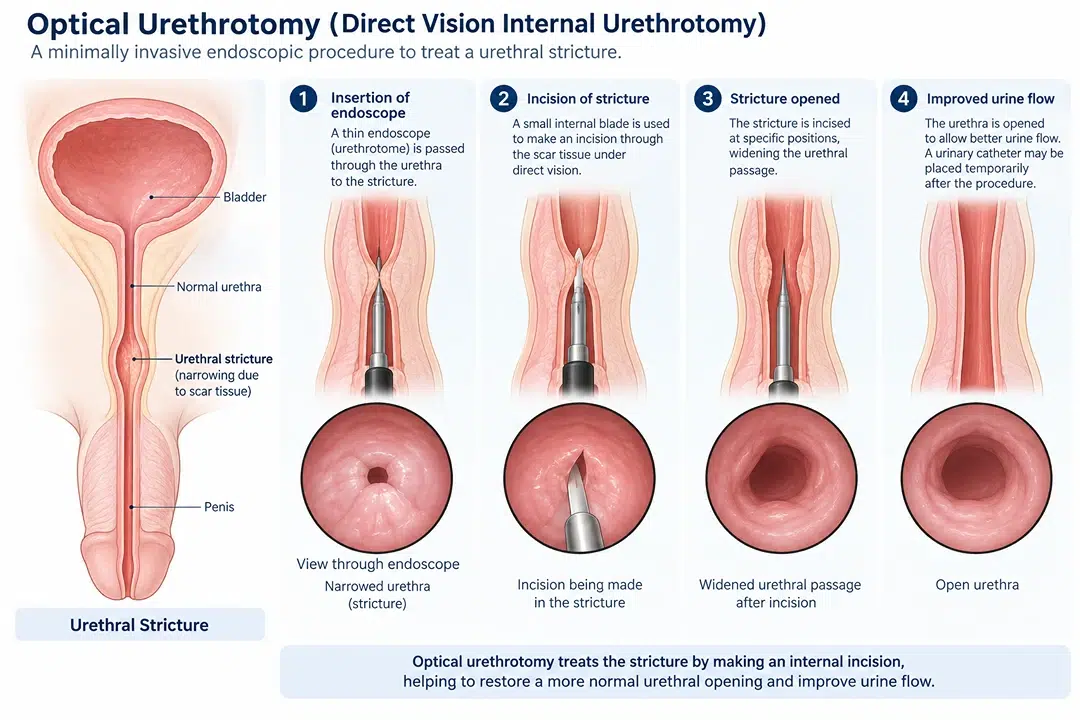
What is Optical Urethrotomy?
Optical urethrotomy is a minimally invasive procedure used to treat selected urethral strictures, in which scar tissue causes narrowing of the urethra and restricts the normal flow of urine. It is also known as direct vision internal urethrotomy (DVIU).
During the procedure, a thin endoscopic instrument called a urethrotome is passed through the urethra until the narrowed area can be seen directly. The scar tissue responsible for the narrowing is then carefully incised, allowing the urethral passage to open and urine to flow more freely.
Unlike urethroplasty, optical urethrotomy does not remove or reconstruct the scarred segment of urethra. Instead, it opens the narrowing internally. This makes it less invasive, but recurrence is an important consideration when deciding whether DVIU is appropriate.
What is Urethral Stricture?
A urethral stricture develops when scar tissue narrows part of the urethra, the tube through which urine leaves the bladder. The narrowing can obstruct urine flow and make emptying the bladder more difficult.
Symptoms may include:
- Weak urinary stream
- Straining to urinate
- Spraying or splitting of the urinary stream
- Taking longer to empty the bladder
- Feeling that the bladder has not emptied completely
- Frequent or urgent urination
- Recurrent urinary tract infections
- Difficulty passing urine or urinary retention
Urethral strictures can develop following previous urethral instrumentation or surgery, trauma, inflammation and certain underlying conditions. In some patients, however, no definite cause is identified.
When is Optical Urethrotomy Recommended?
Optical urethrotomy works best in carefully selected urethral strictures rather than across all types of stricture disease.
Current EAU guidance recommends DVIU or dilation as an option for a primary, single, short (<2 cm), non-obliterative stricture of the bulbar urethra. It may also be considered for a short, veil-like recurrent narrowing following previous bulbar urethroplasty.
Optical urethrotomy may therefore be considered when:
- The stricture is short and confined to an appropriate section of the bulbar urethra.
- The urethra is narrowed but not completely obstructed.
- There is a single stricture rather than extensive or multiple areas of scar tissue.
- The stricture has not undergone repeated unsuccessful endoscopic treatment.
- A short recurrence develops after previous urethroplasty and its characteristics make endoscopic treatment appropriate.
- The expected benefits and likelihood of recurrence have been discussed before treatment.
DVIU is not recommended as a solitary treatment for long strictures greater than 2 cm, and the EAU strongly recommends against its use for penile urethral strictures because of poor outcomes and potential complications. Optilume therapy using a drug-coated balloon is also used in urethral stricture treatment.
How Does Optical Urethrotomy Work?
The procedure is performed through the natural urinary passage without making an external surgical incision.
A small endoscope is carefully advanced through the urethra until the stricture is identified. Because the surgeon can see the narrowing directly, an internal blade or another appropriate endoscopic cutting technique can be used to divide the scar tissue and increase the diameter of the urethral passage.
DVIU can be performed using a traditional cold knife or selected energy-based techniques, including laser urethrotomy. The 2026 EAU guideline concludes that either hot- or cold-knife techniques can be used according to operator experience and available resources, as evidence has not established a consistent long-term advantage of one technique over the other
Optical Urethrotomy vs Urethral Dilation
Both optical urethrotomy and urethral dilation are minimally invasive approaches that aim to open a narrowed urethra, but they achieve this differently.
Urethral dilation gradually stretches the narrowed area using progressively sized instruments or another controlled dilation technique. Optical urethrotomy instead allows the surgeon to see the stricture and make a controlled incision through the scar tissue.
Evidence has not demonstrated that either dilation or DVIU is consistently superior for appropriately selected strictures. Consequently, their indications are broadly similar. Optilume therapy, done using a drug-coated balloon to dilate a narrow passage sustainably, is also used in urethral stricture treatment.
Optical Urethrotomy vs Urethroplasty
The main difference is that optical urethrotomy opens the existing stricture, whereas urethroplasty surgically reconstructs the affected urethra.
Optical urethrotomy involves no external incision and generally has a shorter initial recovery. However, its likelihood of long-term success decreases as stricture length and complexity increase, and repeated urethrotomies can contribute to increasing stricture complexity.
Urethroplasty may therefore be more appropriate for long, penile, complex or repeatedly recurrent strictures. In patients with recurrent anterior urethral strictures, evidence from the OPEN trial found fewer reinterventions after urethroplasty than DVIU over two years.
What to Expect During Optical Urethrotomy
Before Treatment
A detailed assessment helps determine whether the location and characteristics of the stricture make optical urethrotomy an appropriate treatment.
- Medical and urinary history — Your urinary symptoms, previous urethral procedures, infections, injuries and earlier stricture treatments are reviewed.
- Urine flow assessment — Uroflowmetry may be performed to measure the strength and pattern of your urinary stream.
- Residual urine measurement — Ultrasound may be used to determine how much urine remains in the bladder after urination.
- Urethral imaging — A retrograde urethrogram or other imaging may be used to establish the location and length of the stricture.
- Endoscopic assessment — Cystoscopy or urethroscopy may be used where appropriate to examine the narrowing directly.
- Urine testing — Urine may be checked for infection before the procedure.
- Treatment planning — The stricture length, location, degree of narrowing and previous treatments are considered when deciding whether DVIU is suitable.
During Treatment
Optical urethrotomy is performed endoscopically through the urethra.
- Anaesthesia — Appropriate anaesthesia is administered before the procedure.
- Insertion of the urethrotome — The endoscopic instrument is carefully passed through the urethra towards the stricture.
- Identification of the narrowing — The surgeon visualises the scarred section directly.
- Incision of the stricture — The scar tissue is carefully divided to open the narrowed urethral passage.
- Assessment of the opening — The treated area is inspected to ensure that an adequate passage has been achieved.
- Catheter placement — A urinary catheter may be inserted temporarily to allow urine to drain while the treated area begins to heal.
After Treatment
Recovery is generally shorter than after open urethral reconstruction.
- Temporary catheterisation — A catheter may remain in place for a short period after uncomplicated treatment.
- Mild urinary discomfort — Burning or discomfort when urinating can occur temporarily after catheter removal.
- Blood in the urine — A small amount of bleeding or blood-tinged urine may occur during early recovery.
- Fluid intake — Patients may be advised to maintain appropriate hydration after the procedure.
- Activity restrictions — Strenuous activity may need to be limited temporarily according to the surgeon’s instructions.
- Monitoring urine flow — Improvement in urinary stream is assessed after treatment.
- Follow-up — Ongoing monitoring is important because the urethral stricture may recur.
The EAU notes that catheterisation after uncomplicated DVIU generally does not need to extend beyond 72 hours, although actual removal should follow the treating surgeon's instructions.
Benefits of Optical Urethrotomy
For appropriately selected patients, potential benefits include:
- Minimally invasive treatment — The procedure is performed through the urethra without an external surgical incision.
- Improved urine flow — Opening the stricture can reduce obstruction and improve the urinary stream.
- Short procedure and recovery — Recovery is generally quicker than following open urethral reconstruction.
- Temporary catheterisation — Catheter duration is usually relatively short following an uncomplicated procedure.
- No graft harvesting — Unlike some urethroplasty procedures, tissue does not need to be taken from another part of the body.
- Option for selected first-time strictures — DVIU can provide effective treatment for carefully selected short, primary bulbar strictures. Optilume therapy, done using a drug-coated balloon to dilate a narrow passage sustainably, is also used in urethral stricture treatment.
Risks and Limitations of Optical Urethrotomy
The principal limitation of optical urethrotomy is that the scarred tissue can contract again as the urethra heals, resulting in recurrent narrowing.
Potential risks and limitations include:
- Stricture recurrence — The narrowing may return and require further treatment.
- Bleeding — Temporary urethral bleeding or blood in the urine can occur.
- Urinary tract infection — Infection can develop following urethral instrumentation.
- Pain or discomfort — Temporary urethral discomfort may occur during recovery.
- Difficulty urinating — Swelling or recurrent narrowing can temporarily or persistently affect urine flow.
- False passage or urethral injury — Injury to the urethra is uncommon but possible.
- Erectile dysfunction — Changes in erectile function have been reported after DVIU, although the overall risk is relatively low and varies with stricture characteristics.
- Need for additional treatment — Recurrence may eventually require urethroplasty rather than another urethrotomy.
Repeated DVIU or dilation should not simply be continued indefinitely when urethroplasty is a viable option. The EAU recommends against more than two repeated endoscopic procedures with curative intent because repeated manipulation can increase stricture length and complexity without providing reliable long-term freedom from recurrence.
Results of Optical Urethrotomy
Results depend strongly on patient and stricture selection. Short, primary bulbar strictures generally have better outcomes than long, recurrent or more complex strictures.
The 2026 EAU guideline reports that in selected patients with a primary, single, short (<2 cm), non-obliterative bulbar stricture, five-year stricture-free rates of up to approximately 77% have been reported. This represents a selected patient population and should not be interpreted as an expected result for every individual.
The likelihood of failure increases with stricture length, and recurrent strictures frequently require further intervention. Follow-up therefore remains important even when urine flow improves immediately after the procedure.
Summary
Optical urethrotomy, or direct vision internal urethrotomy (DVIU), is a minimally invasive procedure that treats selected urethral strictures by making an internal incision through the scar tissue responsible for narrowing the urethra.
The procedure is most appropriate for carefully selected short, non-obliterative bulbar strictures. Longer, penile, complex or repeatedly recurrent strictures may be better treated with urethroplasty because repeated urethrotomy has a higher likelihood of recurrence.
If a urethral stricture is causing difficulty with urination, consider scheduling a consultation with Dr Joe Lee to discuss whether optical urethrotomy or another treatment approach may be suitable for you.
Frequently Asked Questions
Many patients notice an improved stream once the obstruction has been opened, although temporary swelling and discomfort may affect urination during early recovery.