


Treatment | Urethroplasty |
Also known as | Urethral reconstruction, urethral stricture surgery, reconstructive urethral surgery |
Used for | Urethral strictures causing persistent or recurrent narrowing of the urethra |
How it works | The narrowed section of the urethra is removed or surgically widened and reconstructed to restore an adequate passage for urine |
Types | Excision and primary anastomosis, graft augmentation urethroplasty and staged urethroplasty |
Anaesthesia | Usually general anaesthesia |
Treatment setting | Hospital or surgical facility |
Catheter | A urinary catheter is usually left in place temporarily while the reconstructed urethra heals |
Recovery | Initial recovery takes several weeks, although the duration varies with the extent and type of reconstruction |
Suitable for | Selected patients with urethral strictures requiring definitive surgical reconstruction |
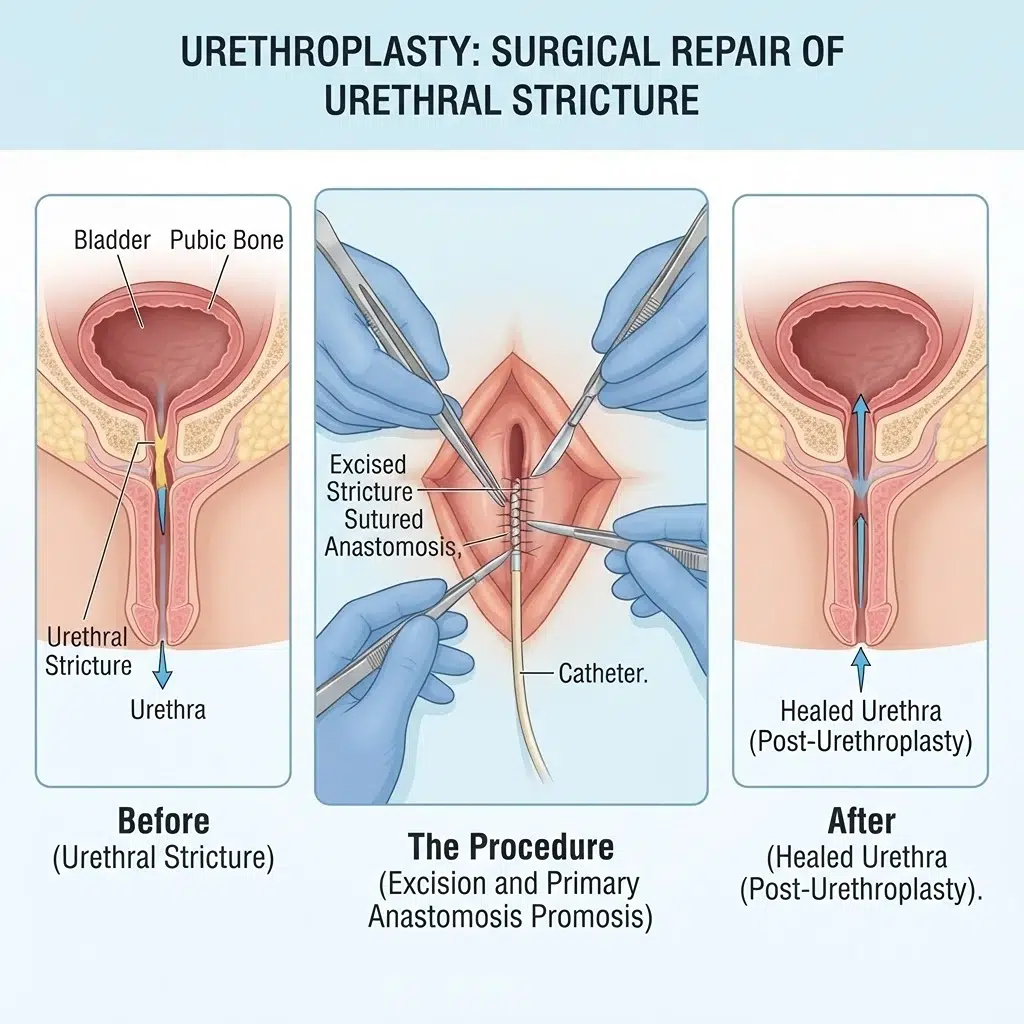
What is Urethroplasty?
Urethroplasty is reconstructive surgery used to treat a urethral stricture, a narrowing of the urethra caused by scar tissue. The urethra is the tube that carries urine from the bladder out of the body. When scar tissue narrows this passage, urine may have difficulty flowing normally.
Depending on its location and severity, a urethral stricture can cause a weak or spraying urinary stream, straining to urinate, incomplete bladder emptying, urinary tract infections and, in severe cases, urinary retention. Urethroplasty aims to restore an adequately open urethral passage by removing the narrowed segment or enlarging and reconstructing it.
Unlike procedures that simply stretch or cut through the narrowed area, urethroplasty reconstructs the affected urethra. The exact operation is selected according to factors including the location, length and severity of the stricture, its underlying cause, previous treatments and the condition of the surrounding tissues.
What Causes a Urethral Stricture?
A urethral stricture develops when injury or inflammation results in scar formation within or around the urethra. As this scar tissue contracts, the urethral opening becomes narrower and restricts urine flow.
Possible causes include:
- Previous urethral procedures or instrumentation — Procedures involving catheters or instruments passed through the urethra can occasionally lead to scar formation.
- Pelvic or perineal trauma — Injury to the pelvis or area between the legs can damage the urethra and subsequently cause narrowing.
- Previous urethral surgery — Strictures may occur following procedures involving the urethra, prostate or surrounding structures.
- Lichen sclerosus — This chronic inflammatory skin condition can affect the urethra and cause complex stricture disease.
- Previous hypospadias surgery — Urethral narrowing can occur years after childhood or adult reconstruction.
- Radiotherapy — Pelvic radiation can cause progressive tissue fibrosis and urethral narrowing.
- Infection or inflammation — Previous inflammatory damage may contribute to scar formation in some patients.
- Unknown cause — In some cases, no definite cause can be identified.
The cause is important because it can influence both the type of reconstruction and the likelihood of recurrence.
When is Urethroplasty Recommended?
Not every urethral stricture requires urethroplasty. Short, uncomplicated strictures may sometimes be managed initially with urethral dilation or direct vision internal urethrotomy (DVIU). However, endoscopic procedures are not appropriate for every stricture and recurrence can occur.
The 2026 EAU guideline advises against using DVIU or dilation alone for long strictures greater than 2 cm and recommends against DVIU for penile urethral strictures. Open urethral reconstruction becomes particularly important for strictures that are unsuitable for endoscopic treatment or recur after previous treatment.
Urethroplasty may therefore be considered when:
- A stricture repeatedly returns after dilation or urethrotomy.
- The stricture is long or complex and unlikely to respond adequately to endoscopic treatment.
- There is significant obstruction to urine flow affecting normal urination.
- The urethra is severely narrowed or completely obstructed.
- The location of the stricture makes endoscopic treatment unsuitable.
- Previous urethral surgery has failed and further reconstruction is required.
- The stricture is associated with trauma, lichen sclerosus or previous hypospadias repair, requiring a more individualised reconstructive approach.
Types of Urethroplasty
There is no single urethroplasty technique suitable for every urethral stricture. The operation is selected according to the stricture’s location, length, severity and underlying cause.
Excision and Primary Anastomosis (EPA)
Excision and primary anastomosis involves removing the narrowed segment of urethra and joining the two healthy ends together without tension.
This technique is particularly established for selected short bulbar urethral strictures. The EAU notes that a short bulbar stricture suitable for this approach is generally one in which the narrowed segment can be removed and the urethral ends reconnected without tension, commonly around 2 cm or less.
Graft Augmentation Urethroplasty
When the stricture is too long or otherwise unsuitable for removal and direct reconnection, the narrowed urethra can instead be opened and widened using a graft.
Oral mucosa, commonly taken from the inside of the cheek, is frequently used because its tissue characteristics make it suitable for urethral reconstruction. The graft is incorporated into the urethra to increase its width while preserving the existing urethral segment. Current EAU guidance recommends free-graft urethroplasty for bulbar strictures that are not suitable for excision and primary anastomosis.
Staged Urethroplasty
Some complex strictures cannot be safely or effectively reconstructed in a single operation. In these cases, reconstruction may be performed in stages.
During the first stage, the scarred urethra is opened and reconstructed, often using graft tissue. After the graft and surrounding tissues have healed, a later operation may be performed to tubularise the reconstructed urethra. Staged reconstruction may be considered in selected complex strictures, including some cases involving previous failed reconstruction or significantly compromised local tissues.
Urethroplasty vs Urethral Dilation or DVIU
Urethral dilation gradually stretches the narrowed portion of the urethra, while direct vision internal urethrotomy (DVIU) uses an endoscopic instrument to make an incision through the stricture. Both are performed through the urethra without an open reconstruction.
These procedures can be appropriate for selected strictures. Current EAU guidance allows DVIU or dilation as an initial option for a primary, single, short, non-obliterative bulbar stricture, but advises against using these procedures alone for long strictures or DVIU for penile strictures.
Urethroplasty differs because the scarred segment is surgically reconstructed rather than simply opened temporarily. The choice between these approaches depends on the location and length of the stricture, previous treatment, severity of obstruction and the individual patient’s circumstances.
What to Expect During Urethroplasty
Before Surgery
A detailed evaluation is required to establish the extent of the stricture and select the most appropriate reconstructive technique.
- Medical and urinary history — Your urinary symptoms, previous procedures, infections, injuries and other possible causes of urethral narrowing are reviewed.
- Urine flow assessment — Uroflowmetry may be performed to measure the strength and pattern of urine flow.
- Residual urine measurement — Ultrasound may be used to determine how much urine remains in the bladder after urination.
- Urethral imaging — A retrograde urethrogram and/or voiding cystourethrogram may be used to identify the location and length of the stricture.
- Endoscopic assessment — Cystoscopy or urethroscopy may be performed in selected cases to directly assess the narrowed area.
- Urine testing — Urine is checked for infection before surgery, with treatment provided when required.
- Planning the reconstruction — The location, length and severity of the stricture help determine whether an anastomotic, graft-based or staged reconstruction is appropriate.
If the urethra has recently undergone dilation, DVIU or other manipulation, a period of urethral rest may be recommended before reconstruction so that the true extent of the scar tissue can be assessed more accurately.
During Surgery
The procedure is performed under anaesthesia, with the surgical technique determined by the characteristics of the stricture.
- Accessing the urethra — The surgeon reaches the affected section through an incision appropriate to the location of the stricture.
- Identifying the scarred segment — The narrowed urethra and surrounding scar tissue are carefully assessed.
- Reconstructing the urethra — A short stricture may be removed and the healthy ends reconnected, while longer strictures may be opened and widened using graft tissue.
- Harvesting graft tissue where required — For graft urethroplasty, tissue may be obtained from inside the cheek (buccal mucosa graft) and prepared for reconstruction.
- Checking the reconstruction — The repaired urethra is assessed to ensure an adequate passage has been restored.
- Catheter placement — A urinary catheter is positioned across the reconstructed area to divert urine and support healing.
- Closing the surgical site — The incision is closed once reconstruction and catheter placement are complete.
After Surgery
Recovery varies according to the type and complexity of urethroplasty performed.
- Early recovery — Temporary discomfort, swelling or bruising around the surgical area may occur and gradually improve.
- Urinary catheter — The catheter remains in place while the reconstructed urethra heals and should not be removed until advised by the surgeon.
- Catheter assessment before removal — Imaging may be performed in selected patients to check for urinary leakage before the catheter is removed.
- Wound care — Instructions are provided for caring for the incision and, when oral mucosa has been used, the graft donor site inside the mouth.
- Activity restrictions — Heavy lifting, strenuous exercise, cycling and activities that place pressure on the surgical area are restricted during early recovery.
- Temporary sexual restriction — Sexual activity is avoided until sufficient healing has occurred and the surgeon advises that it is safe to resume.
- Follow-up — Urinary flow and symptoms are monitored because urethral strictures can recur even after successful reconstruction.
What is a Buccal Mucosa Graft?
A buccal mucosa graft is tissue taken from the inner lining of the cheek and used to widen or reconstruct a narrowed urethra. Oral mucosa is commonly used in urethroplasty because it is accustomed to a moist environment and has properties that make it suitable for incorporation into urethral tissue.
During graft urethroplasty, a carefully measured piece of tissue is removed from inside the mouth and transferred to the narrowed urethral segment. The stricture is opened and the graft is secured in position to increase the calibre of the urethral passage.
Patients may experience temporary mouth discomfort, tightness or altered sensation at the donor site following surgery. The need for a graft and the amount required depend on the length, location and complexity of the urethral stricture.
Benefits of Urethroplasty
For appropriately selected patients, urethroplasty offers several potential benefits:
- Restoration of urine flow — Reconstruction widens the narrowed urethral passage and reduces obstruction.
- Improvement in urinary symptoms — A weak stream, straining and incomplete emptying may improve after successful reconstruction.
- Definitive reconstruction — The operation addresses the scarred urethral segment rather than repeatedly stretching or cutting it.
- Treatment of longer or complex strictures — Reconstructive techniques can treat strictures that are unsuitable for simple endoscopic procedures.
- Reduced need for repeated procedures — Successful reconstruction may reduce dependence on repeated dilation or urethrotomy.
- Different techniques for different strictures — The reconstruction can be tailored to the location, length, cause and condition of the affected urethra.
Urethroplasty generally provides the highest likelihood of durable urethral patency among treatments for urethral stricture disease, although results vary according to the type of stricture and reconstruction performed.
Risks and Limitations of Urethroplasty
As with any reconstructive surgery, urethroplasty carries potential risks and cannot guarantee that a stricture will never return.
- Recurrent urethral stricture — Scar tissue can develop again and may require further treatment.
- Bleeding or haematoma — Bleeding can occur around the surgical area during early recovery.
- Infection — Urinary or wound infection can occur following surgery.
- Urinary leakage — Leakage from the reconstructed urethra may occur before healing is complete.
- Temporary urinary symptoms — Spraying, urgency or changes in the urinary stream may occur during recovery.
- Changes in penile or perineal sensation — Temporary numbness or altered sensation can occur depending on the surgical approach.
- Sexual complications — Changes in erectile or ejaculatory function can occur after some forms of urethral reconstruction, although the risk varies considerably with stricture location, cause and surgical technique.
- Oral graft-site symptoms — Buccal graft harvesting can cause temporary mouth pain, tightness or altered sensation.
- Need for additional treatment — Recurrent or particularly complex strictures may require further endoscopic or reconstructive procedures.
Most reported complications following anterior urethroplasty are minor, but recurrence and other complications remain possible, which is why postoperative surveillance is recommended.
Results of Urethroplasty
The outcome of urethroplasty depends on the location, length and cause of the stricture, the condition of surrounding tissue, previous procedures and the reconstructive technique used.
For example, the 2026 EAU guideline reports a composite patency rate of approximately 93.8% for transecting excision and primary anastomosis in appropriately selected short bulbar strictures. For bulbar strictures unsuitable for this technique, free-graft urethroplasty has reported patency rates of approximately 88–91% at short- to medium-term follow-up. These figures apply to specific patient groups and techniques and should not be interpreted as an individual guarantee of success.
Successful treatment is generally reflected by an improved urinary stream and an adequately open urethra without the need for further intervention. Because recurrence can occur after reconstruction, follow-up remains an important part of treatment even when urinary symptoms have improved.
Summary
Urethroplasty is reconstructive surgery for urethral stricture disease that aims to restore an adequately open urethral passage and improve urine flow. Depending on the stricture, treatment may involve removing a short narrowed segment and reconnecting the healthy urethra or widening a longer segment using graft tissue.
The appropriate technique depends on factors including the location, length and cause of the stricture, previous treatments and the condition of the surrounding tissues. More complex strictures may require graft-based or staged reconstruction rather than a single procedure.
If a urethral stricture is causing persistent urinary symptoms or has returned after previous treatment, consider scheduling a consultation with Dr Joe Lee to discuss whether urethroplasty or another treatment approach may be suitable for you.
Frequently Asked Questions
Yes, the donor area generally heals after surgery, although temporary soreness, tightness or altered sensation can occur during recovery.