

| Treatment | No-Scalpel Vasectomy |
|---|---|
| Also known as | Non-scalpel vasectomy (NSV), keyhole vasectomy |
| Used for | Permanent male contraception |
| How it works | The vas deferens are divided and sealed through a tiny puncture in the scrotum, preventing sperm from mixing with the semen during ejaculation. |
| Anaesthesia | Local anaesthesia |
| Treatment setting | Day procedure |
| Recovery | Most men return to light activities within a few days and gradually resume normal activities over the following week |
| Suitable for | Men who have completed their families or are certain they do not wish to father children in the future |
A vasectomy is a safe and effective form of permanent male contraception for men who have decided they do not wish to father children in the future. The procedure works by preventing sperm from mixing with the semen during ejaculation, thereby preventing pregnancy without affecting normal sexual function.
The no-scalpel vasectomy is a minimally invasive variation of the conventional vasectomy. Instead of making surgical incisions in the scrotum, a tiny puncture is used to access the vas deferens, which may result in less tissue disruption, minimal bleeding and a quicker recovery.
It is important to understand that a vasectomy does not provide immediate contraception, and alternative contraception must be used until follow-up semen analysis confirms that no sperm remain in the semen.
What is a No-Scalpel Vasectomy?
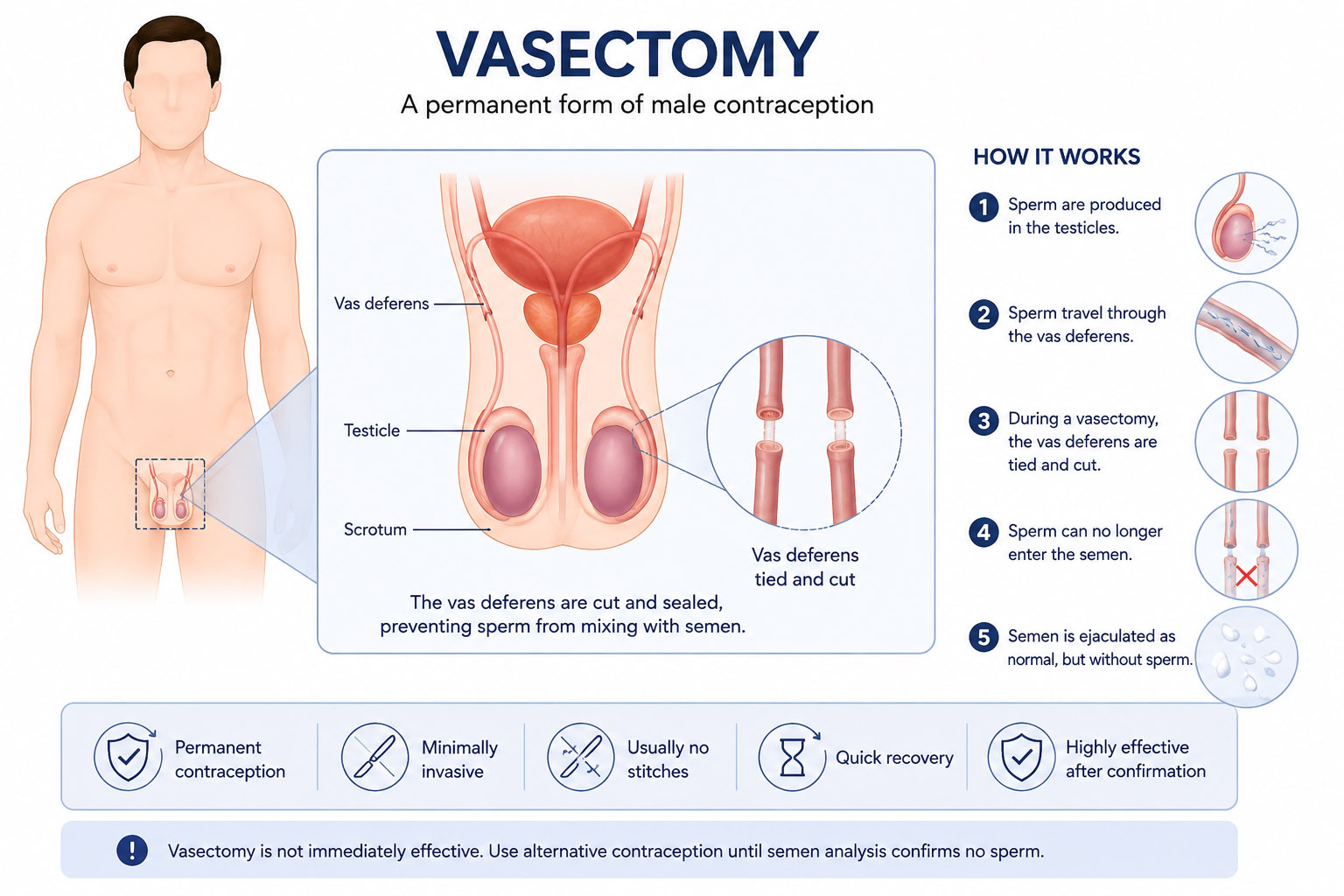
A no-scalpel vasectomy is a minimally invasive surgical procedure performed for permanent male contraception. During the procedure, the vas deferens, the tubes that carry sperm from the testicles, are divided and sealed through a tiny puncture in the scrotal skin. This prevents sperm from mixing with the semen that is ejaculated during sexual activity.
Unlike a conventional vasectomy, which requires small incisions, the no-scalpel technique uses a specialised instrument to create a small opening in the scrotum without the need for a scalpel. Sperm continue to be produced by the testicles after the procedure but are naturally absorbed by the body because they can no longer travel into the semen. The procedure does not affect testosterone production, sexual desire, ejaculation or the ability to achieve orgasm.
How Does a No-Scalpel Vasectomy Work?
Under normal circumstances, sperm are produced in the testicles and travel through the vas deferens before mixing with the semen during ejaculation. A no-scalpel vasectomy interrupts this pathway by permanently blocking the vas deferens, preventing sperm from reaching the semen.
Although sperm are no longer present in the ejaculate after sterility has been confirmed, the body continues to produce sperm, which are naturally broken down and reabsorbed. Because the procedure does not affect hormone production or blood flow to the penis, normal sexual function is generally maintained.
- Normal sperm transport — Sperm are produced in the testicles and travel through the vas deferens before mixing with the semen during ejaculation.
- Access through a tiny puncture — A specialised instrument creates a small opening in the scrotal skin, avoiding the need for a scalpel incision.
- Isolation of the vas deferens — Each vas deferens is carefully brought to the surface through the small puncture.
- Division and sealing of the vas deferens — The tubes are divided and sealed to prevent sperm from entering the semen.
- Normal ejaculation continues — Semen continues to be ejaculated after the procedure, but it no longer contains sperm once follow-up semen analysis confirms sterility.
Watch Dr Joe Lee explain how a no-scalpel vasectomy is performed and what makes this minimally invasive technique different from a conventional vasectomy.
@drjollyurology 15–20 minutes. No-scalpel. Small puncture. Done 🩺 A simple outpatient procedure with a fast recovery. vasectomy urology menshealth doctorsoftiktok fyp
♬ original sound - Dr Joe Lee | Urology - Dr Joe Lee | Urology
Who May Consider a No-Scalpel Vasectomy?
A no-scalpel vasectomy is intended for men seeking a reliable, long-term method of contraception. Because the procedure should be regarded as permanent, careful consideration and counselling are important before proceeding.
You may consider a no-scalpel vasectomy if you:
- Have completed your family — You have the number of children you want and do not intend to have more.
- Are certain you do not wish to father children in the future — You have made an informed decision that permanent contraception aligns with your long-term family planning goals (link to service page: family planning).
- Are seeking permanent contraception — You want a highly effective contraceptive option that does not require ongoing maintenance or regular medication.
- Prefer a minimally invasive procedure — The no-scalpel technique avoids surgical incisions and is associated with less tissue disruption than a conventional vasectomy.
- Prefer not to rely on other contraceptive methods — You are looking for a permanent alternative to temporary methods such as condoms or contraception used by your partner.
A consultation with a urologist is important to discuss your medical history, family planning goals and the permanent nature of the procedure before deciding whether a no-scalpel vasectomy is right for you.
What to Expect During a No-Scalpel Vasectomy?
Before the Procedure
Before undergoing a no-scalpel vasectomy, your urologist will ensure that you understand the procedure and that permanent contraception is appropriate for your circumstances. This typically includes:
- Consultation — Discussion of your medical history, general health and reasons for choosing permanent contraception.
- Family planning discussion — Confirmation that you understand the permanent nature of the procedure and have carefully considered your future reproductive plans.
- Physical examination — Examination of the scrotum and surrounding structures to assess suitability for the procedure.
- Explanation of the procedure — Your urologist will explain how the vasectomy is performed, its benefits, limitations and potential risks.
- Informed consent — You will have the opportunity to ask questions before providing consent for the procedure.
- Pre-procedure instructions — Guidance may be provided regarding hygiene, medications and preparing for the day of the procedure.
During the Procedure
A no-scalpel vasectomy is usually performed under local anaesthesia as a day procedure. During the procedure, your urologist will:
- Administer local anaesthesia — The scrotal area is numbed to minimise discomfort during the procedure.
- Create a tiny puncture — A specialised instrument creates a small opening in the scrotal skin without using a scalpel.
- Isolate the vas deferens — Each vas deferens is carefully brought through the puncture.
- Divide and seal the vas deferens — The tubes are divided and sealed to prevent sperm from entering the semen.
- Complete the procedure — The tiny puncture usually heals without stitches and a small dressing may be applied if required.
After the Procedure
Most patients are able to return home shortly after the procedure. Following a no-scalpel vasectomy, you can generally expect:
- A short observation period — You will be monitored briefly before being discharged.
- Same-day discharge — The procedure is usually performed on an outpatient basis.
- Mild discomfort or bruising — Temporary soreness, swelling or bruising may occur and generally improves over several days.
- Scrotal support and ice packs — These may help reduce discomfort and swelling during the initial recovery period.
- Gradual return to normal activities — Light activities can usually be resumed within a few days, while strenuous exercise should be avoided until advised by your urologist.
- Continued contraception — Alternative contraception must be used until follow-up semen analysis confirms that no sperm remain in the semen.
- Follow-up semen analysis — A semen sample is tested after the procedure to confirm successful sterility before relying solely on the vasectomy for contraception.
Benefits of a No-Scalpel Vasectomy
A no-scalpel vasectomy provides a reliable, long-term contraceptive option for men who have completed their families or no longer wish to father children. Potential benefits include:
- Permanent contraception — Once sterility has been confirmed, a vasectomy provides a highly effective long-term method of preventing pregnancy.
- Minimally invasive technique — The no-scalpel approach uses a tiny puncture rather than surgical incisions, resulting in less tissue disruption.
- No scalpel incision — Avoiding a scalpel incision may reduce bleeding and minimise scarring.
- Usually no stitches required — The small puncture typically heals naturally without the need for sutures.
- Short recovery period — Most men return to light daily activities within a few days and recover more quickly than with conventional surgical techniques.
- Does not affect testosterone or sexual function — The procedure does not interfere with testosterone production, sexual desire, erections, ejaculation or orgasm.
- Highly effective after sterility is confirmed — Once follow-up semen analysis confirms the absence of sperm, a no-scalpel vasectomy is one of the most effective forms of permanent contraception.
Risks and Limitations of a No-Scalpel Vasectomy
A no-scalpel vasectomy is generally considered a safe and effective procedure when performed by an experienced urologist. However, like any surgical procedure, it carries potential risks and limitations that should be discussed before treatment.
Potential risks and limitations include:
- Mild pain or discomfort — Temporary soreness or tenderness around the scrotum is common during the first few days after the procedure.
- Bruising or swelling — Mild bruising or swelling around the puncture site may occur and usually resolves as healing progresses.
- Bleeding or haematoma — Small amounts of bleeding or a collection of blood within the scrotum (haematoma) (link to service page) may occasionally develop.
- Infection — Although uncommon, infection can occur at the puncture site and may require treatment with antibiotics.
- Sperm granuloma — A small inflammatory lump may form if sperm leak from the divided vas deferens. This is usually benign and often resolves without significant treatment.
- Chronic scrotal pain — A small number of men may experience persistent scrotal discomfort following a vasectomy, although this is uncommon.
- The procedure should be regarded as permanent — Although vasectomy reversal may be possible in selected cases, it is more complex, not always successful and should not be relied upon as part of family planning.
- Sterility is not immediate — Sperm remain in the reproductive tract after the procedure, so alternative contraception must be used until semen analysis confirms the absence of sperm.
- Small risk of failure or recanalisation — Rarely, the divided ends of the vas deferens may reconnect (recanalisation), allowing sperm to reappear in the semen even after an initially successful procedure.
Your urologist will explain the potential risks, expected outcomes and the importance of follow-up semen analysis before you decide to undergo a no-scalpel vasectomy.
What Results Can Patients Expect from a No-Scalpel Vasectomy?
A no-scalpel vasectomy is intended to provide reliable, long-term contraception for men who no longer wish to father children. However, it is important to understand that the procedure does not produce immediate sterility and follow-up testing is essential before relying on it as the sole method of contraception.
Following a no-scalpel vasectomy, patients can generally expect:
- Highly effective permanent contraception — Once semen analysis confirms the absence of sperm, a vasectomy is one of the most effective methods of permanent contraception.
- Gradual clearance of sperm — Sperm already present within the reproductive tract continue to be ejaculated for a period of time after the procedure before they are completely cleared.
- Follow-up semen analysis — One or more semen samples are required to confirm successful sterility before alternative contraception can be discontinued.
- Normal ejaculation — Semen continues to be ejaculated after a vasectomy, although it no longer contains sperm once sterility has been confirmed.
- Sexual function remains unchanged — Testosterone production, sexual desire, erections and the ability to achieve orgasm are generally unaffected by the procedure.
- Long-term contraception without ongoing maintenance — After sterility has been confirmed, no regular medication or contraceptive devices are required to maintain its contraceptive effect.
Although a no-scalpel vasectomy provides highly effective permanent contraception, it should only be chosen by men who are confident they do not wish to father children in the future.
Summary
A no-scalpel vasectomy is a minimally invasive procedure that provides permanent male contraception by preventing sperm from entering the semen. Using a tiny puncture instead of a surgical incision, the procedure is associated with minimal tissue disruption, a relatively quick recovery and excellent long-term effectiveness once sterility has been confirmed.
Although sperm continue to be produced after the procedure, they are naturally reabsorbed by the body, while testosterone production, ejaculation, erections and sexual desire remain unchanged. Follow-up semen analysis is an essential part of treatment to confirm that the vasectomy has been successful before relying on it for contraception.
If you are considering permanent contraception, schedule a consultation with Dr Joe Lee to discuss whether a no-scalpel vasectomy is the right option for your family planning goals.