


| Treatment | Penile Implant Surgery |
|---|---|
| Also known as | Penile Prosthesis Implantation |
| Used for | Erectile dysfunction that has not responded adequately to non-surgical treatments or when other treatments are unsuitable |
| Types | Inflatable and malleable penile implants |
| How it works | An implanted device allows the penis to become firm enough for sexual activity |
| Anaesthesia | Usually performed under general or regional anaesthesia |
| Hospital stay | Usually one overnight stay, although some patients may be discharged the same day depending on the surgical plan and recovery |
| Recovery | Initial healing usually takes several weeks; sexual activity resumes only after clearance from the surgeon |
| Suitable for | Carefully selected men with persistent erectile dysfunction following specialist assessment |
Erectile dysfunction (ED) is the persistent inability to achieve or maintain an erection firm enough for satisfactory sexual activity. While many men respond well to treatments such as oral medication, penile injections or vacuum erection devices, these options may not be effective or suitable for everyone.
For men with persistent erectile dysfunction that has not improved with non-surgical treatments, a penile implant may be considered. Also known as a penile prosthesis, it is a surgically implanted medical device designed to provide sufficient rigidity for sexual activity.
Following a comprehensive assessment, your urologist can determine whether a penile implant is an appropriate treatment option based on your underlying condition, treatment history and individual needs.
What is a Penile Implant?
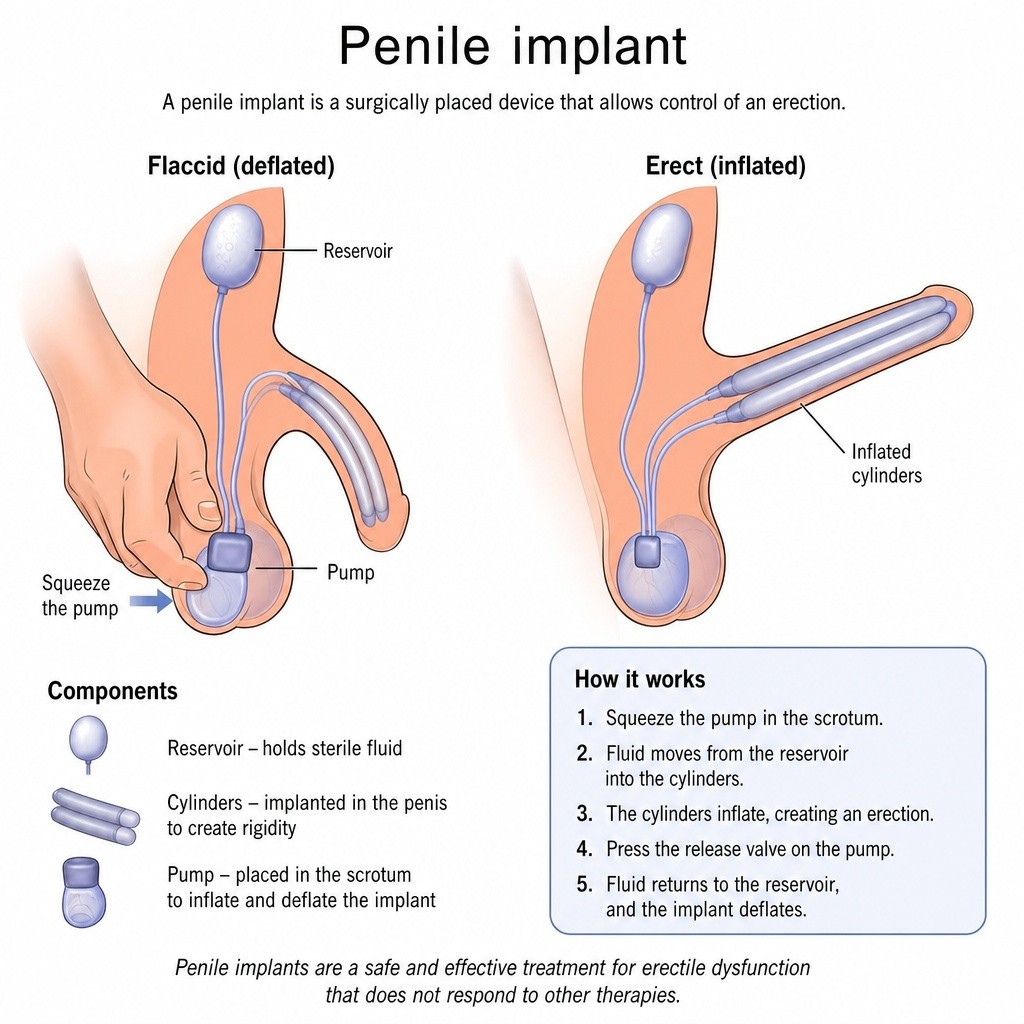
A penile implant, also known as a penile prosthesis, is a medical device that is surgically placed inside the penis to help men with erectile dysfunction achieve sufficient rigidity for sexual activity. Unlike oral medications that depend on improving blood flow, a penile implant provides mechanical support to produce an erection when required.
The implant is completely concealed beneath the skin and is not visible from the outside. Two main types are available, known as inflatable and malleable implants and the most suitable option depends on factors such as your overall health, lifestyle, manual dexterity and personal preferences. Because implantation permanently changes the erectile tissue, it is generally considered when other treatment options have been unsuccessful or are not appropriate.
Types of Penile Implants
Two main types of penile implants are available. Both are designed to provide sufficient penile rigidity for sexual activity, but they differ in their design and method of operation. Your urologist will recommend the most suitable option based on your medical condition, lifestyle and individual preferences.
Inflatable Penile Implant
- Implant components — An inflatable implant consists of cylinders placed inside the penis that are connected to a concealed pump. Depending on the implant design, a fluid reservoir may also be placed within the body.
- Creating an erection — Squeezing the pump transfers fluid into the cylinders, causing the penis to become firm enough for sexual activity.
- Returning to a relaxed state — After sexual activity, a release mechanism allows the fluid to return to the reservoir, returning the penis to a softer, flaccid state.
- Appearance when not in use — Because the implant can be inflated and deflated, the penis generally has a more natural appearance when not erect.
Malleable Penile Implant
- Implant structure — A malleable implant consists of two bendable rods placed within the erectile chambers of the penis.
- Creating an erection — The penis is manually positioned upwards for sexual activity.
- Returning to the resting position — After intercourse, the penis is simply bent downwards for comfort and concealment beneath clothing.
- Simple design — Malleable implants contain fewer mechanical components and may be suitable for men who prefer a simpler device or have difficulty operating an inflatable implant.
The most appropriate implant depends on your individual circumstances, expectations and medical needs, which will be discussed during your consultation.
How Does a Penile Implant Work?
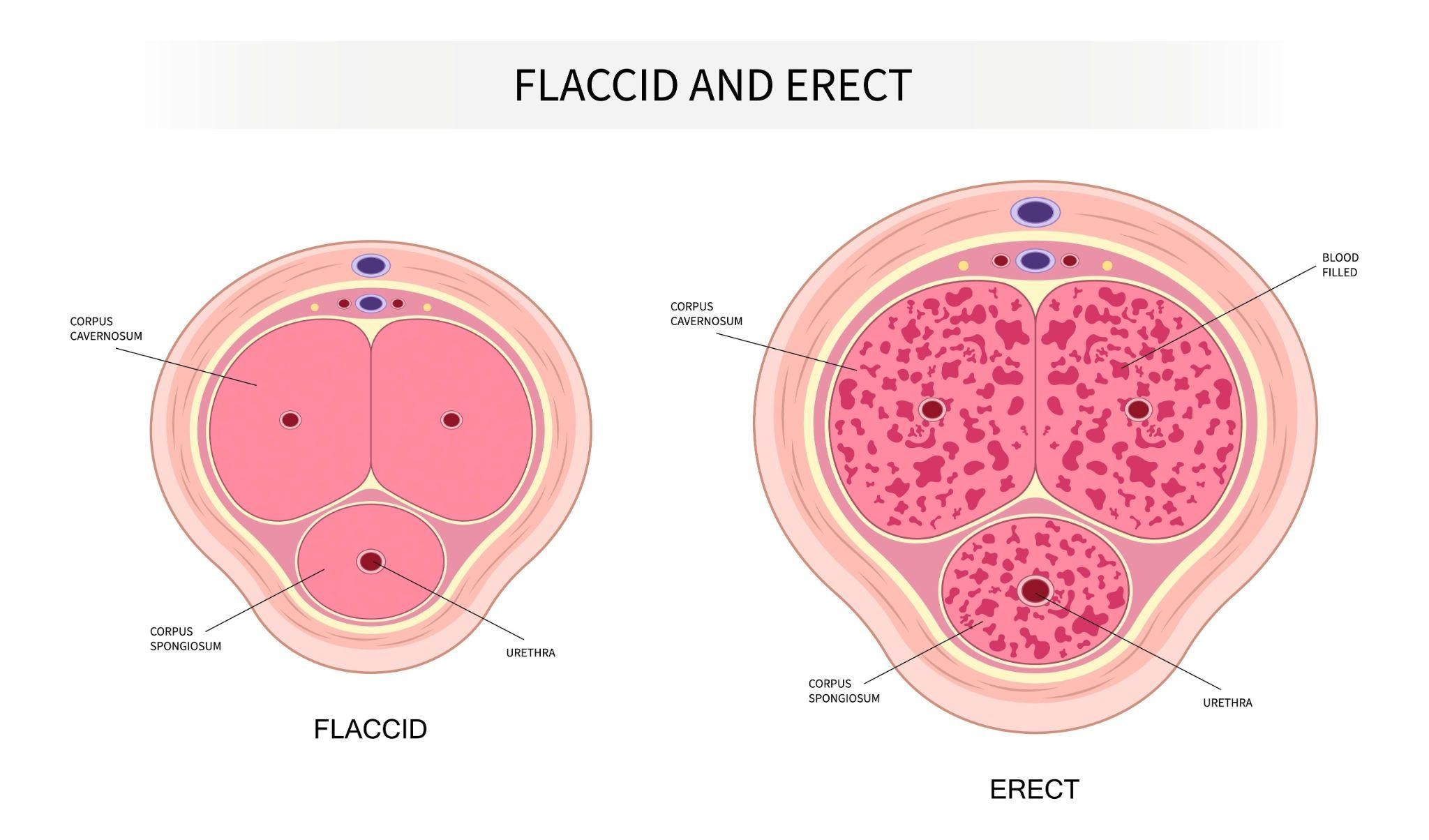
During a natural erection, sexual stimulation causes increased blood flow into the erectile tissue of the penis. As the erectile tissue fills with blood, the penis becomes firm enough for sexual activity. In men with erectile dysfunction, this process may be affected by reduced blood flow, nerve damage, previous surgery or other medical conditions, making it difficult to achieve or maintain an erection.
A penile implant works differently from oral medication or shockwave therapy. Rather than improving blood flow, it provides mechanical support inside the penis, allowing an erection to be achieved when desired. The implant remains completely concealed within the body and is operated only when needed.
- Normal erectile function — During sexual stimulation, increased blood flow fills the erectile tissue, allowing the penis to become firm.
- Erectile dysfunction — Conditions such as vascular disease, diabetes, nerve injury or previous pelvic surgery may prevent sufficient blood flow or nerve signalling, making erections difficult to achieve or maintain.
- Placement of the implant — During surgery, inflatable cylinders or malleable rods are positioned within the erectile chambers of the penis.
- Creation of rigidity — An inflatable implant is activated by squeezing a concealed pump, while a malleable implant is manually positioned for sexual activity.
- Return to the resting position — Inflatable implants can be deflated after use, while malleable implants are bent back into a comfortable resting position.
A penile implant provides mechanical rigidity for sexual activity but does not increase sexual desire or automatically initiate an erection. Sexual arousal remains an important part of normal sexual function.
Watch Dr Joe Lee explain how penile implants work, the different types available, and who may be suitable for this treatment.
@drjollyurology Two types of implants, one goal: Restore function! Find out how these life-changing devices work. 🩺 urology menshealthawareness doctorsoftiktok fyp EDawareness
♬ original sound - Dr Joe Lee | Urology - Dr Joe Lee | Urology
Who May Benefit from a Penile Implant?
Penile implants are generally considered when other treatments for erectile dysfunction have not provided satisfactory results or are not appropriate. Following a comprehensive assessment, your urologist will determine whether a penile implant is the most suitable treatment for your condition.
You may be a suitable candidate if you have:
- Persistent erectile dysfunction — Erectile dysfunction that continues despite appropriate treatment and management of contributing medical conditions.
- An inadequate response to oral medication — Oral medications such as sildenafil or tadalafil do not provide sufficient or consistent erections.
- Difficulty using other ED treatments — Penile injections, vacuum erection devices or other non-surgical treatments have been ineffective, unsuitable or unacceptable.
- Erectile dysfunction following pelvic or prostate surgery — Erectile function has not recovered adequately following procedures such as radical prostatectomy or other pelvic surgery.
- Certain structural penile conditions — Selected men with erectile dysfunction and significant penile curvature, such as Peyronie’s disease, may benefit from penile implant surgery following specialist assessment.
- A preference for a definitive surgical treatment — Men who understand the permanent nature of the procedure, together with its benefits, limitations and potential risks, may choose a penile implant as a long-term treatment option.
Ultimately, suitability for penile implant surgery can only be determined after a thorough consultation and assessment with your urologist.
What to Expect During Penile Implant Surgery?
Penile implant surgery is performed in a hospital under anaesthesia and requires careful planning before the procedure. Although the exact surgical approach varies depending on the type of implant and individual patient factors, the treatment generally follows the same sequence of assessment, surgery and postoperative recovery.
Before surgery
- Medical assessment — Your urologist will review your overall health, erectile dysfunction, previous treatments, medications and surgical history to determine whether a penile implant is appropriate.
- Physical examination — An examination of the penis and surrounding tissues is performed to assess penile anatomy, skin health and any conditions that may influence surgery.
- Selection of the implant — Inflatable and malleable implants will be discussed, and the most suitable option will be recommended based on your medical condition, lifestyle and personal preferences.
- Discussion of expectations — Your urologist will explain the expected benefits, potential limitations, recovery process and how the implant functions after surgery.
- Preparation for surgery — You will receive instructions regarding fasting, medication adjustments, personal hygiene and measures to help reduce the risk of infection.
During surgery
- Administration of anaesthesia — The procedure is performed under general or regional anaesthesia to ensure your comfort throughout surgery.
- Small surgical incision — A carefully planned incision is made to access the erectile chambers of the penis.
- Placement of the implant — Inflatable cylinders or malleable rods are positioned within the erectile tissue according to the chosen implant type.
- Placement of additional components — For inflatable implants, the pump and, where applicable, the fluid reservoir are positioned beneath the skin through the same or additional small incisions.
- Closure of the incision — Once the implant has been tested and correctly positioned, the incision is closed and a dressing is applied.
After surgery
- Postoperative monitoring — You will be monitored while recovering from anaesthesia, and the surgical team will assess pain, urination and the surgical site. Depending on your recovery and surgical plan, you may stay in the hospital for one or two days before being discharged.
- Pain and swelling management — Medication and postoperative instructions are provided to help manage discomfort and support healing.
- Wound care — You will receive advice on caring for the incision and recognising signs that require medical attention.
- Activity restrictions — Strenuous exercise and sexual activity should be avoided until your urologist confirms that healing is sufficient.
- Device training — Once healing has progressed, you will be shown how to safely operate your implant, particularly if you have an inflatable device.
- Follow-up appointments — Regular reviews allow your urologist to monitor healing, assess implant function and address any concerns.
Benefits of Penile Implants
Penile implants provide a surgical treatment option for carefully selected men with erectile dysfunction when non-surgical treatments have not been successful or are unsuitable. Although individual outcomes vary, many men experience reliable erectile rigidity and high treatment satisfaction following implantation.
Potential benefits include:
- Reliable rigidity — The implant can provide sufficient penile firmness for sexual activity when functioning correctly.
- Control over timing — The implant can be activated or positioned whenever an erection is desired.
- Completely concealed within the body — All components are surgically implanted beneath the skin and are not visible externally.
- No medication required before sexual activity — Once recovery is complete, erection support does not depend on taking oral medication immediately beforehand.
- Long-term treatment option — Penile implants are designed for continued long-term use, although no mechanical device can be guaranteed to last indefinitely.
- May improve treatment satisfaction — Carefully selected patients and their partners often report improved confidence and satisfaction when expectations are realistic.
Risks and Limitations of Penile Implant Surgery
Penile implant surgery is generally safe when performed by an experienced urologist. However, as with any surgical procedure, there are potential risks and limitations that should be discussed before treatment.
Potential risks and limitations include:
- Infection — Although uncommon, an implant infection may require antibiotics, implant removal or further surgery.
- Bleeding, bruising or swelling — These are expected during the early stages of recovery and usually improve as healing progresses.
- Pain or discomfort — Mild to moderate discomfort is common after surgery, but persistent or worsening pain should be assessed by your urologist.
- Mechanical failure — Like any implanted mechanical device, the implant may wear out or malfunction over time.
- Implant erosion or displacement — In rare cases, parts of the implant may move from their intended position or place pressure on surrounding tissues.
- Changes in perceived penile length — A penile implant does not increase penile size, and some men may perceive a difference in penile length compared with previous erections.
- Need for revision surgery — Additional surgery may occasionally be required to replace or remove the implant because of infection, mechanical failure or other complications.
- Permanent treatment decision — Implant surgery permanently changes the erectile tissue, meaning natural erections should not be expected if the implant is removed.
Recovery After Penile Implant Surgery
Recovery following penile implant surgery occurs gradually over several weeks. While most men recover well, healing times vary depending on the individual, the type of implant used and the extent of the surgery.
Your urologist will provide personalised instructions throughout your recovery to help ensure proper healing and teach you how to use the implant safely before resuming sexual activity.
During recovery, you can generally expect:
- Early recovery — Mild swelling, bruising and tenderness around the surgical area are common during the initial healing period.
- Return to routine activities — Most daily activities can gradually be resumed according to your comfort and your urologist’s recommendations, while strenuous activity should be avoided until healing is adequate.
- Incision care — Keeping the surgical wound clean and monitoring for signs of infection are important parts of recovery.
- Implant activation — Inflatable implants are usually not activated until sufficient healing has occurred and your urologist confirms it is appropriate.
- Return to sexual activity — Sexual activity should only resume after your urologist has assessed your recovery and confirmed that healing is complete.
- Ongoing follow-up — Follow-up appointments allow your urologist to monitor healing, assess implant function and answer any questions as you become familiar with the device.
What Results Can Patients Expect from Penile Implants?
A penile implant is designed to provide dependable mechanical rigidity for sexual activity when other erectile dysfunction treatments have not been successful. While it can produce a firm erection suitable for intercourse, it does not recreate every aspect of a natural erection, and individual outcomes vary depending on your underlying health and recovery.
What patients can generally expect includes:
- Erection on demand — The implant can be activated or positioned whenever sexual activity is desired.
- Consistent mechanical support — The implant provides penile rigidity without relying on the blood flow changes required for a natural erection.
- No automatic increase in sexual desire — Sexual desire is influenced by hormonal, psychological and relationship factors and is not altered by the implant.
- Sensation and orgasm — These are not created by the implant and generally depend on your underlying nerve function and overall health.
- Appearance varies — The appearance of the penis in both the flaccid and erect state varies according to the type of implant, your anatomy and the surgical outcome.
- Adjustment takes time — Most men require time to recover from surgery, learn how to operate the implant and become comfortable using it.
- Long-term monitoring remains important — Regular follow-up helps ensure the implant continues to function well and allows any concerns to be addressed promptly.
Summary
Penile implants are a well-established surgical treatment for men with erectile dysfunction when other treatment options have been ineffective or are unsuitable. By providing mechanical rigidity for sexual activity, penile implants offer a reliable long-term solution that does not rely on medications or natural blood flow to achieve an erection.
Although penile implant surgery has high satisfaction rates among appropriately selected patients, it is a permanent procedure that requires careful consideration of its benefits, limitations and potential risks. A comprehensive consultation with a urologist is essential to determine whether a penile implant is the most appropriate treatment option based on your individual needs and treatment goals.
If erectile dysfunction has not improved with other treatments, schedule a consultation with Dr Joe Lee to discuss whether a penile implant may be suitable for you.